
A density bonus is extra units above what base zoning allows, granted in exchange for restricting some of them to below market rents or sale prices. The city gets affordable housing without writing a check. The developer gets units that pay for the ones given up.
There is no national standard and no federal program. Zoning is a local power, so roughly 1,000 programs across 31 states each set their own rules. Two parcels a state line apart can return a 15% bonus and a 50% bonus for the same commitment.
Running the bonus early, before you commit to a set-aside, helps ensure:
- Land Price: A 50% bonus changes what a parcel can support, which is often what makes a marginal site work
- Deal Structure: The restricted units cost revenue and the bonus units return it, and that ratio moves with every percentage point of set-aside
- Entitlement Strategy: Most programs pair the density increase with concessions, and on a tight site the parking relief is worth more than the units
How to Calculate a Density Bonus
A density bonus is not a single formula. What you earn depends on your program, your tier, and how deep the affordability goes.
Step 1: Base Allowable Units
Start with the most units your base zoning permits before any bonus.
Base Allowable Units = Site Acres x Maximum Allowed DU/Acre
For example: 2.00 acres x 60 DU/acre = 120 units
If your zone has no density cap, use the unit count the envelope supports. The bonus is a percentage of this number, so an error here scales straight through to the answer.
Step 2: Affordability Tier and Set-Aside
Programs sort affordability into tiers, usually very low, low, and moderate income, each with a minimum set-aside below which you earn nothing. Deeper affordability earns more bonus per unit restricted. Moderate income tiers are often limited to for-sale product.
Step 3: Bonus Percentage Earned
Read your ordinance to find what it pays in, because the three largest programs in the country each pay in something different. Some pay one flat bonus for one set-aside. Others slide with the set-aside, and most sliding scales are written as a table rather than a formula.
Do not draw a straight line between the first and last row of a table unless the code says the scale is linear. A stepped table and a straight line only agree at the endpoints.
Step 4: Bonus Units and Affordable Units
Convert the percentage into unit counts.
For example: 120 units earning a 50% bonus is 60 extra units, for 180 total, with 18 restricted at a 15% set-aside.
Most codes measure the set-aside against the base project rather than the bonused total, which is what keeps the bonus units market rate. Fractional units usually round up.
Three Programs, Three Different Currencies
A bonus number copied from one city means nothing in another, because the three programs that produce the most housing each pay in a different unit of account.
California Pays in Units
Government Code 65915 is a stepped table, not a formula. Very low income earns 20% at a 5% set-aside and hits the 50% cap at 15%. Low income needs 24% for the same cap, and moderate income, for-sale only, needs 44%. Depth beats breadth: ten restricted units buy 33 more units at very low income and 5 at moderate.
New York Pays in Floor Area
The Universal Affordability Preference, adopted December 2024 under City of Yes, applies in R6 through R10. Every square foot of affordable floor area buys one square foot of bonus, up to the district cap. R10 goes from 10.0 to 12.0 FAR, R8 on a wide street from 7.2 to 8.64, and R6A from 3.0 to 3.9, which is 30% rather than 20%. Affordability is permanent at a weighted average of 60% AMI. This is not Mandatory Inclusionary Housing, which grants no floor area at all and simply attaches a requirement when the Council rezones land.
Austin Pays in Feet of Height
Density Bonus Citywide took effect June 1, 2026 and replaced DB90 and Vertical Mixed Use, both now closed to new applications. It grants 15 to 60 extra feet in commercial districts for 10% of units at 50% MFI. The Downtown Density Bonus was restructured in May into DDB400 and DDB850. A 60 foot grant on a 40 foot base is worth six extra floors. The same 60 feet on a 350 foot base is worth five out of thirty one. The ordinance number means nothing until you know your base.
What a Density Bonus Does Not Cover
Any screening estimate models one tier at a time and leaves out stacking provisions that layer a second bonus on a maxed-out first one, fee-in-lieu and off-site compliance, senior and student housing rules, statutory parking caps, and the design and green building requirements several programs attach as a condition of participating.
Treat the result as a rough order of magnitude, not legal advice, and confirm it with your planning department and counsel before it reaches an offer.
How to Find Your Binding Constraint
A density bonus raises one ceiling. It leaves the others exactly where they were.
Take a 2.00 acre site zoned 60 DU/acre, with a 45 ft height limit, a 2.0 FAR cap, and surface parking at 1.5 stalls per unit. Four limits apply:
- Density cap: 120 units
- Height limit: 145 units
- FAR cap: 182 units
- Parking capacity: 105 units
This site supports 105 units, and it is parking-limited. Now earn a 50% bonus. The density cap moves to 180. Height, FAR, and parking do not move at all, so the answer is still 105.
The units come back only when you use the parking concession. Drop the ratio from 1.5 stalls per unit to 1.0 and the same 158 stalls serve 158 units, so height becomes the constraint at 145.
That is a 40 unit gain, and the concession delivered it, not the density increase. Read only the bonus percentage and you would have booked 60 units the site cannot build.
Calculate Density Bonus Yield on a Real Site Plan with TestFit
Access Up-to-Date Zoning Data for Density, Height, and Parking
Instead of flipping through zoning code to find base density, height limits, setbacks, and parking minimums, TestFit gives you instant access to the parameters that set your base unit count right within your site planning environment. The bonus is a percentage of that base, so it is only as good as the base.
Image caption: BUILT-IN ZONING DATA IN TESTFIT
Test Bonus Units Against Height, Parking, and Setbacks
A density bonus is only useful if the extra units fit. TestFit runs the bonused unit count against your real parcel boundary and shows you whether height, parking, or setbacks governs, so you know which concession to ask for before you file.
Image caption: GET A PASS/FAIL SCORE FOR DENSITY
Find the Yield the Concessions Unlock
Once you know which standard is holding the site back, TestFit generates and compares schemes that test the concession against the alternative. Trade surface stalls for structured parking, restack the unit mix, or take the setback relief, and see which returns the most of the bonus you earned.
Image caption: UNIT MIX WITH GENERATIVE DESIGN
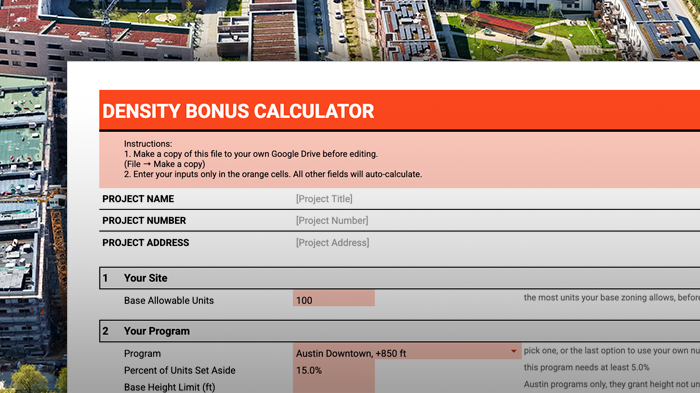
Download the Density Bonus Calculator to test the bonus on your site.